Beauty Beyond Bounds
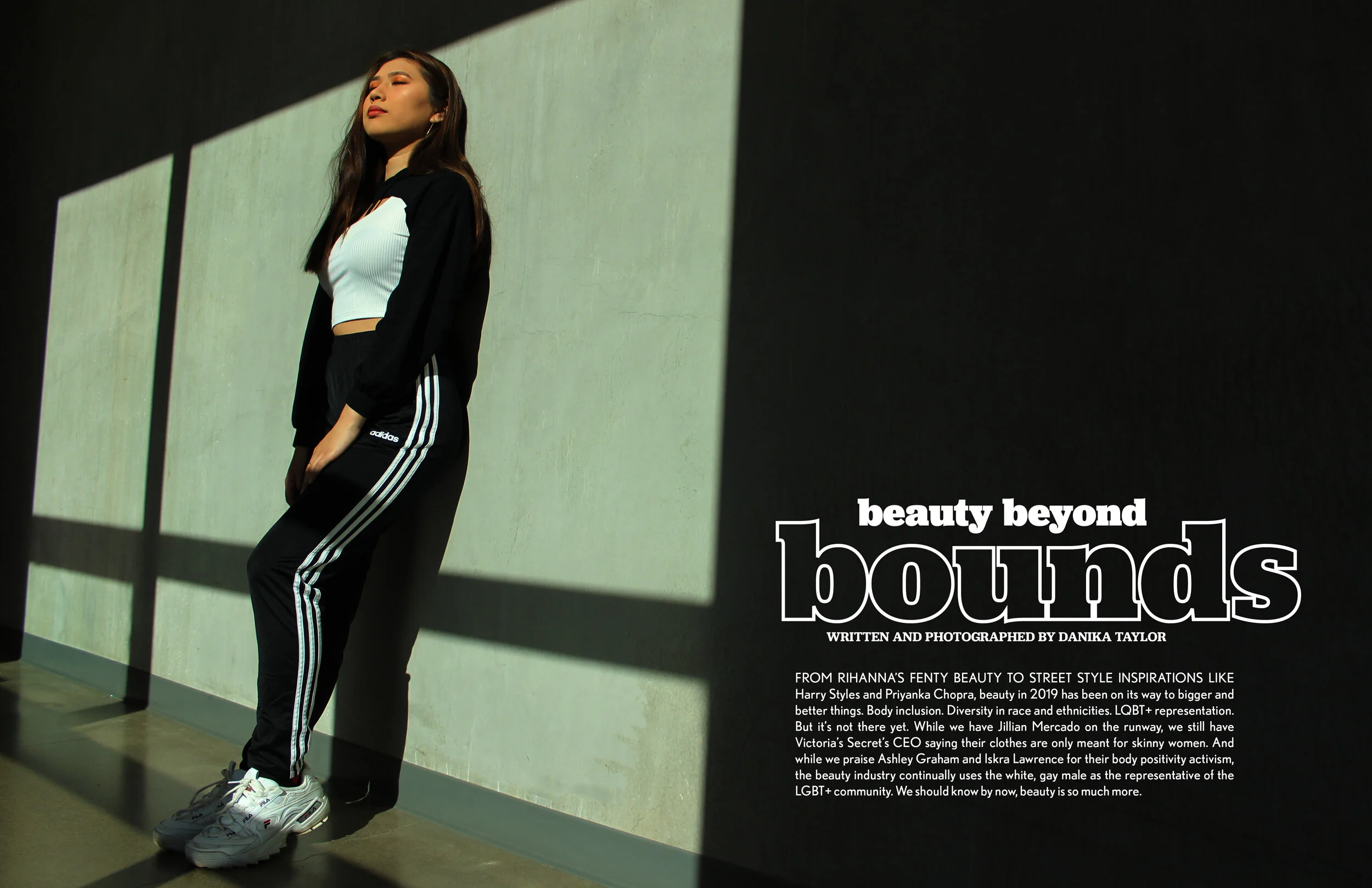
From Rihanna’s Fenty Beauty to street style inspirations like Harry Styles and Priyanka Chopra, beauty in 2019 has been on its way to bigger and better things. Body inclusion. Diversity in race and ethnicities. LQBT+ representation. But it’s not there yet. While we have Jillian Mercado on the runway, we still have Victoria’s Secret’s CEO saying their clothes are only meant for skinny women. And while we praise Ashley Graham and Iskra Lawrence for their body positivity activism, the beauty industry continually uses the white, gay male as the representative of the LGBT+ community. We should know by now, beauty is so much more.
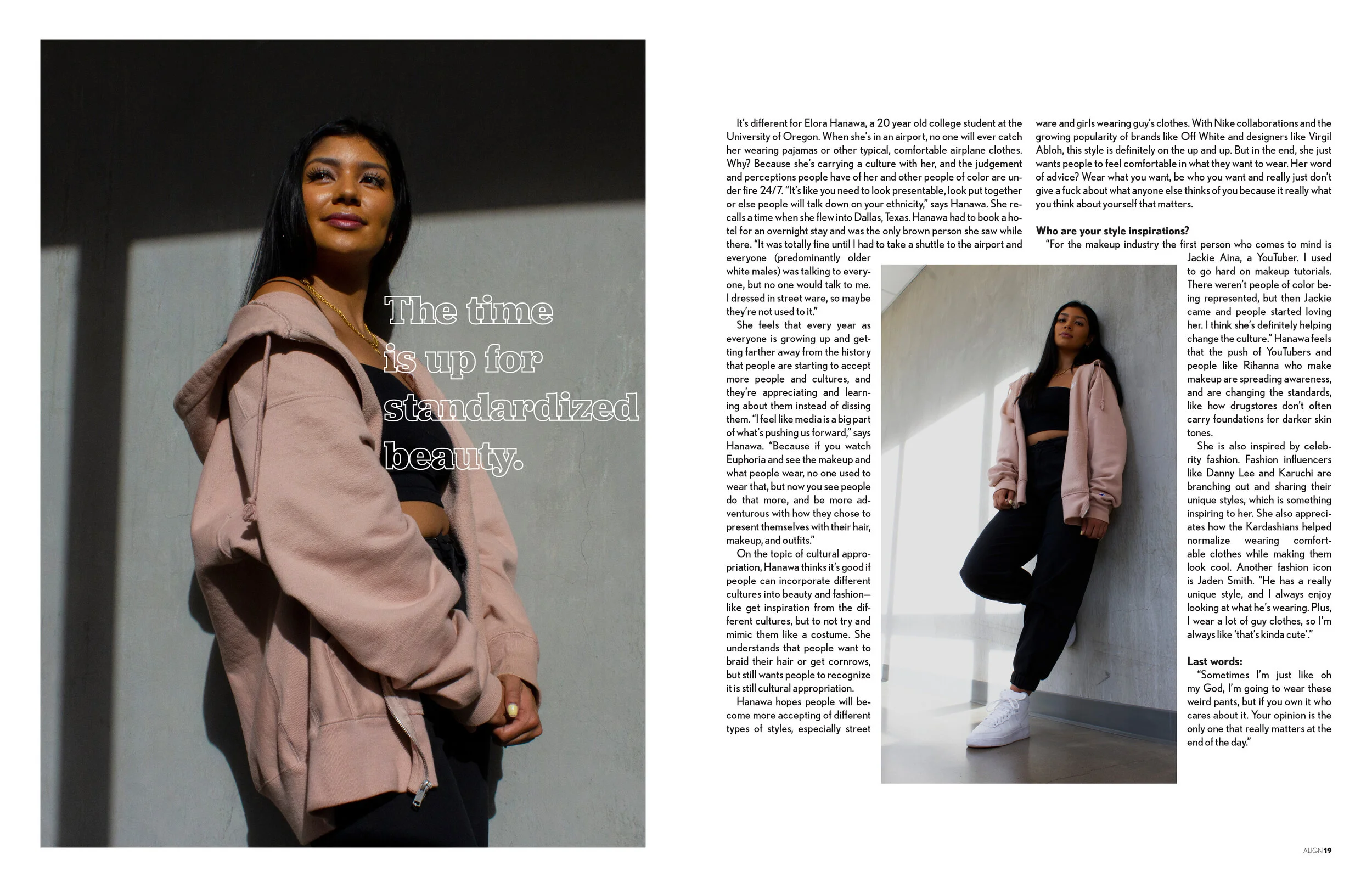
Elora Hanawa
It’s different for Elora Hanawa, a 20 year old college student at the University of Oregon. When she’s in an airport, no one will ever catch her wearing pajamas or other typical, comfortable airplane clothes. Why? Because she’s carrying a culture with her, and the judgement and perceptions people have of her and other people of color are under fire 24/7. “It’s like you need to look presentable, look put together or else people will talk down on your ethnicity,” says Hanawa. She recalls a time when she flew into Dallas, Texas. Hanawa had to book a hotel for an overnight stay and was the only brown person she saw while there. “It was totally fine until I had to take a shuttle to the airport and everyone (predominantly older white males) was talking to everyone, but no one would talk to me. I dressed in street ware, so maybe they’re not used to it.”
She feels that every year as everyone is growing up and getting farther away from the history that people are starting to accept more people and cultures, and they’re appreciating and learning about them instead of dissing them. “I feel like media is a big part of what’s pushing us forward,” says Hanawa. “Because if you watch Euphoria and see the makeup and what people wear, no one used to wear that, but now you see people do that more, and be more adventurous with how they chose to present themselves with their hair, makeup, and outfits.”
On the topic of cultural appropriation, Hanawa thinks it’s good if people can incorporate different cultures into beauty and fashion—like get inspiration from the different cultures, but to not try and mimic them like a costume. She understands that people want to braid their hair or get cornrows, but still wants people to recognize it is still cultural appropriation.
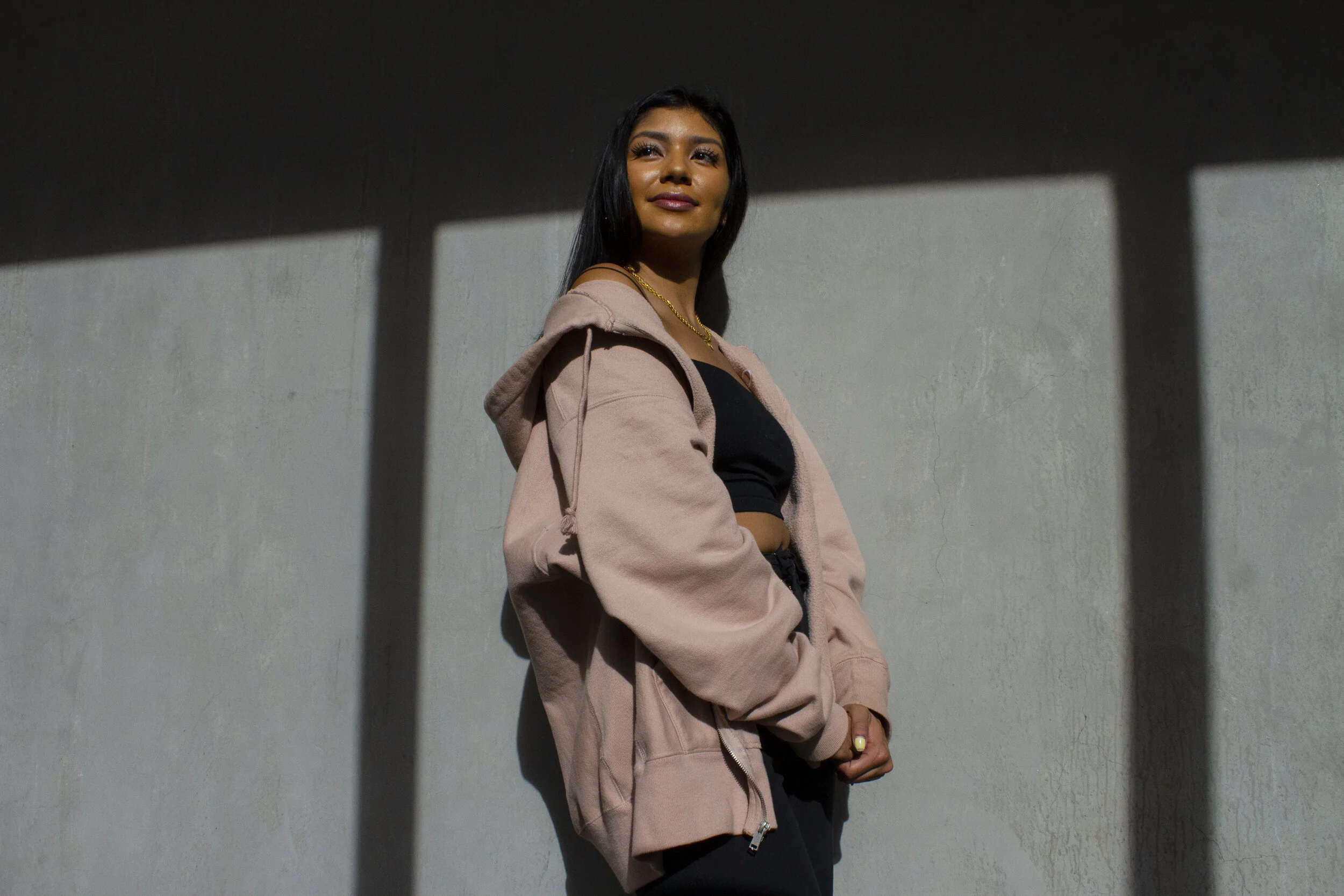
Hanawa hopes people will become more accepting of different types of styles, especially street ware and girls wearing guy’s clothes.
With Nike collaborations and the growing popularity of brands like Off White and designers like Virgil Abloh, this style is definitely on the up and up. But in the end, she just wants people to feel comfortable in what they want to wear. Her word of advice? Wear what you want, be who you want and really just don’t give a fuck about what anyone else thinks of you because it really what you think about yourself that matters.
Who are your style inspirations?
“For the makeup industry the first person who comes to mind is Jackie Aina, a YouTuber. I used to go hard on makeup tutorials. There weren’t people of color being represented, but then Jackie came and people started loving her. I think she’s definitely helping change the culture.” Hanawa feels that the push of YouTubers and people like Rihanna who make makeup are spreading awareness, and are changing the standards, like how drugstores don’t often carry foundations for darker skin tones.
She is also inspired by celebrity fashion. Fashion influencers like Danny Lee and Karuchi are branching out and sharing their unique styles, which is something inspiring to her. She also appreciates how the Kardashians helped normalize wearing comfortable clothes while making them look cool. Another fashion icon is Jaden Smith. “He has a really unique style, and I always enjoy looking at what he’s wearing. Plus, I wear a lot of guy clothes, so I’m always like ‘that’s kinda cute’.”
Last words:
“Sometimes I’m just like oh my God, I’m going to wear these weird pants, but if you own it who cares about it. Your opinion is the only one that really matters at the end of the day.”
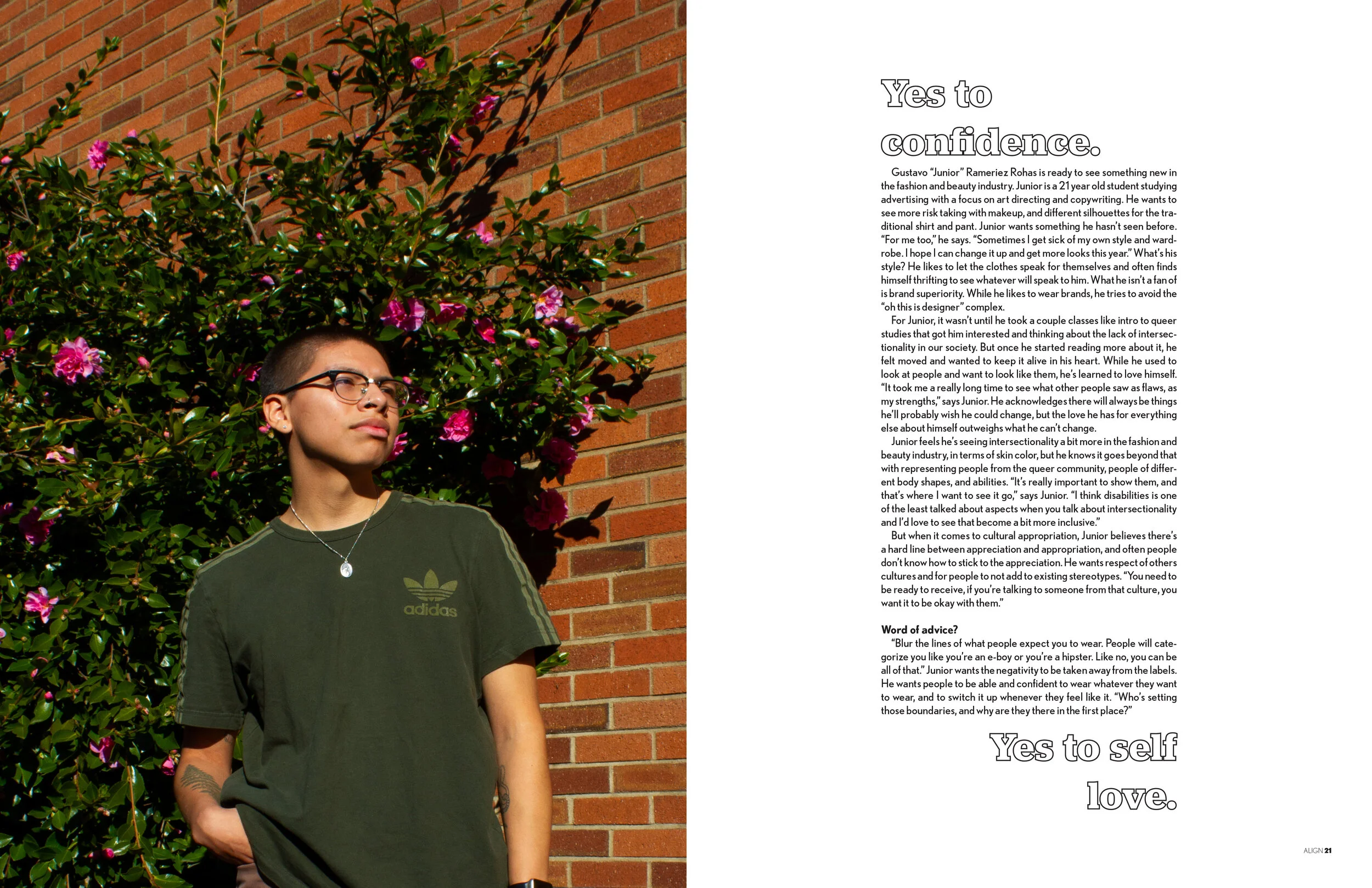
Gustavo “Junior” Rameriez Rohas
Gustavo “Junior” Rameriez Rohas is ready to see something new in the fashion and beauty industry. Junior is a 21 year old student studying advertising with a focus on art directing and copywriting. He wants to see more risk taking with makeup, and different silhouettes for the traditional shirt and pant. Junior wants something he hasn’t seen before. “For me too,” he says. “Sometimes I get sick of my own style and wardrobe. I hope I can change it up and get more looks this year.” What’s his style? He likes to let the clothes speak for themselves and often finds himself thrifting to see whatever will speak to him. What he isn’t a fan of is brand superiority. While he likes to wear brands, he tries to avoid the “oh this is designer” complex.
For Junior, it wasn’t until he took a couple classes like intro to queer studies that got him interested and thinking about the lack of intersectionality in our society. But once he started reading more about it, he felt moved and wanted to keep it alive in his heart. While he used to look at people and want to look like them, he’s learned to love himself. “It took me a really long time to see what other people saw as flaws, as my strengths,” says Junior.
He acknowledges there will always be things he’ll probably wish he could change, but the love he has for everything else about himself outweighs what he can’t change.
Junior feels he’s seeing intersectionality a bit more in the fashion and beauty industry, in terms of skin color, but he knows it goes beyond that with representing people from the queer community, people of different body shapes, and abilities. “It’s really important to show them, and that’s where I want to see it go,” says Junior. “I think disabilities is one of the least talked about aspects when you talk about intersectionality and I’d love to see that become a bit more inclusive.”
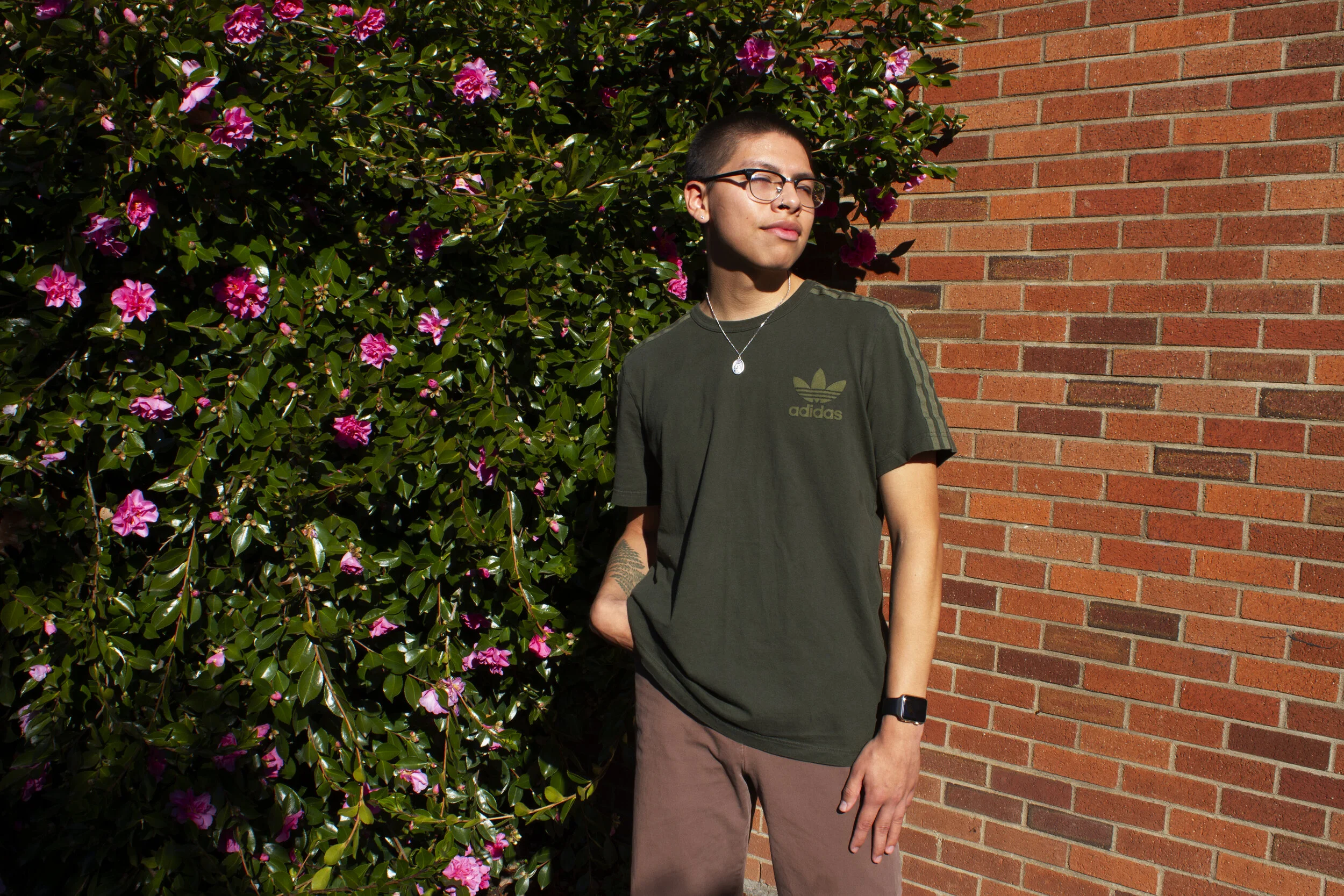
“Blur the lines of what people expect you to wear. People will categorize you like you’re an e-boy or you’re a hipster. Like no, you can be all of that.”
But when it comes to cultural appropriation, Junior believes there’s a hard line between appreciation and appropriation, and often people don’t know how to stick to the appreciation. He wants respect of others cultures and for people to not add to existing stereotypes. “You need to be ready to receive, if you’re talking to someone from that culture, you want it to be okay with them.”
Junior wants the negativity to be taken away from the labels. He wants people to be able and confident to wear whatever they want to wear, and to switch it up whenever they feel like it. “Who’s setting those boundaries, and why are they there in the first place?”
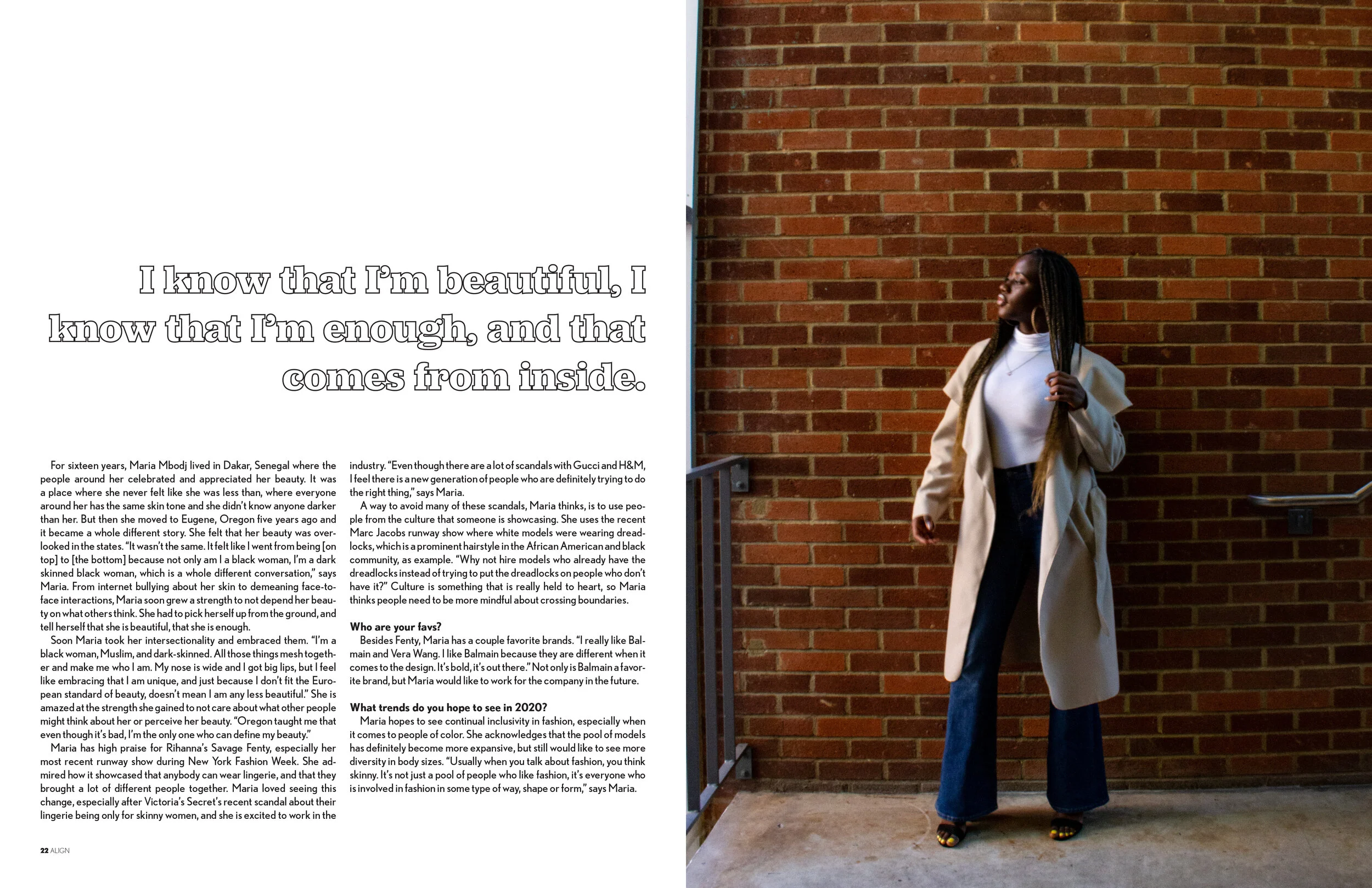
Maria Mbodj
For sixteen years, Maria Mbodj lived in Dakar, Senegal where the people around her celebrated and appreciated her beauty. It was a place where she never felt like she was less than, where everyone around her has the same skin tone and she didn’t know anyone darker than her. But then she moved to Eugene, Oregon five years ago and it became a whole different story. She felt that her beauty was overlooked in the states. “It wasn’t the same. It felt like I went from being [on top] to [the bottom] because not only am I a black woman, I’m a dark skinned black woman, which is a whole different conversation,” says Maria. From internet bullying about her skin to demeaning face-to-face interactions, Maria soon grew a strength to not depend her beauty on what others think. She had to pick herself up from the ground, and tell herself that she is beautiful, that she is enough.
Soon Maria took her intersectionality and embraced them. “I’m a black woman, Muslim, and dark-skinned. All those things mesh together and make me who I am. My nose is wide and I got big lips, but I feel like embracing that I am unique, and just because I don’t fit the European standard of beauty, doesn’t mean I am any less beautiful.” She is amazed at the strength she gained to not care about what other people might think about her or perceive her beauty. “Oregon taught me that even though it’s bad, I’m the only one who can define my beauty.”
Maria has high praise for Rihanna’s Savage Fenty, especially her most recent runway show during New York Fashion Week. She admired how it showcased that anybody can wear lingerie, and that they brought a lot of different people together. Maria loved seeing this change, especially after Victoria’s Secret’s recent scandal about their lingerie being only for skinny women, and she is excited to work in the industry.
“Even though there are a lot of scandals with Gucci and H&M, I feel there is a new generation of people who are definitely trying to do the right thing.”
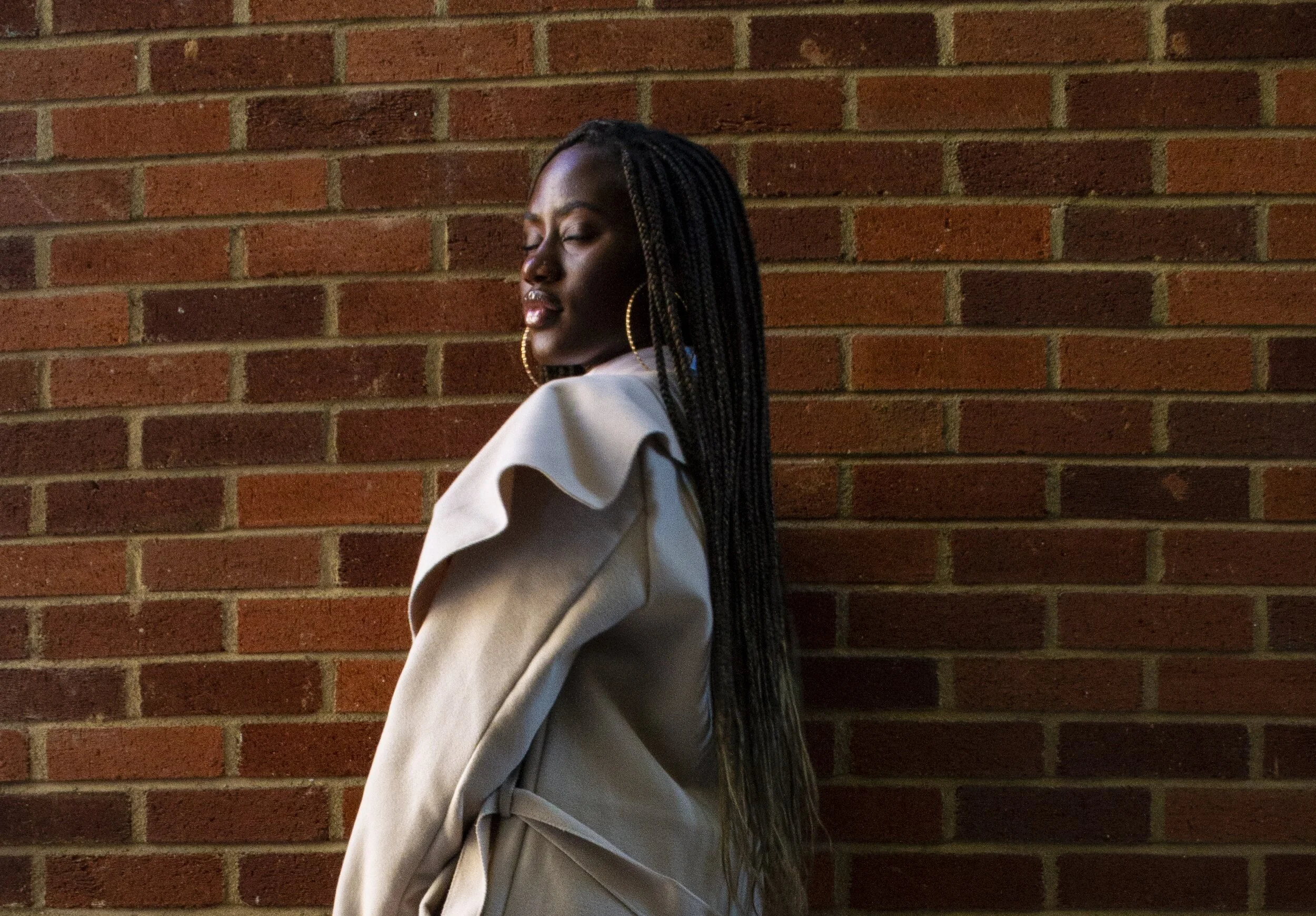

A way to avoid many of these scandals, Maria thinks, is to use people from the culture that someone is showcasing. She uses the recent Marc Jacobs runway show where white models were wearing dreadlocks, which is a prominent hairstyle in the African American and black community, as example. “Why not hire models who already have the dreadlocks instead of trying to put the dreadlocks on people who don’t have it?” Culture is something that is really held to heart, so Maria thinks people need to be more mindful about crossing boundaries.
Who are your favs?
Besides Fenty, Maria has a couple favorite brands. “I really like Balmain and Vera Wang. I like Balmain because they are different when it comes to the design. It’s bold, it’s out there.” Not only is Balmain a favorite brand, but Maria would like to work for the company in the future.
What trends do you hope to see in 2020?
Maria hopes to see continual inclusivity in fashion, especially when it comes to people of color. She acknowledges that the pool of models has definitely become more expansive, but still would like to see more diversity in body sizes. “Usually when you talk about fashion, you think skinny. It’s not just a pool of people who like fashion, it’s everyone who is involved in fashion in some type of way, shape or form,” says Maria.
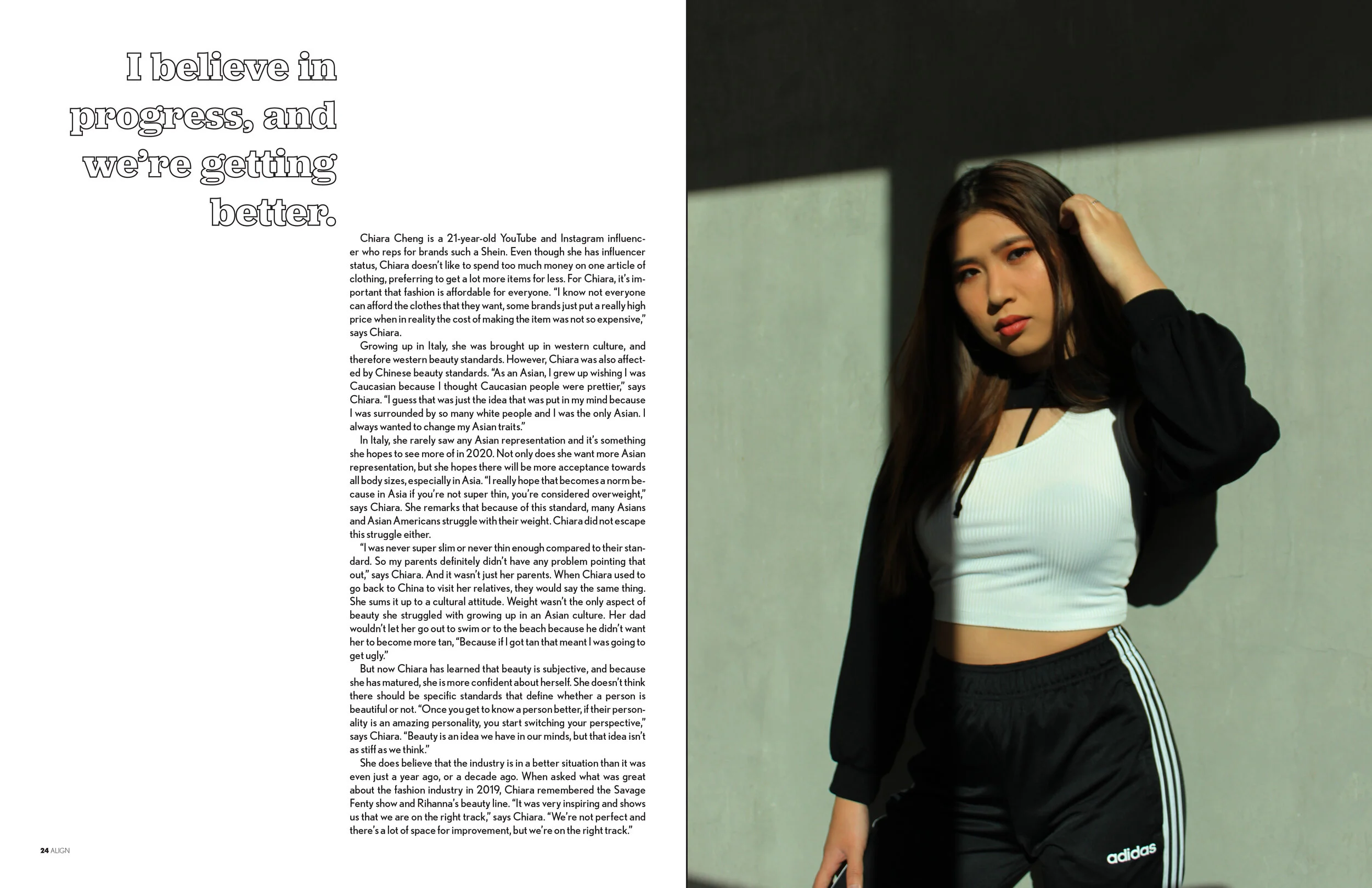
Chiara Cheng
Chiara Cheng is a 21-year-old YouTube and Instagram influencer who reps for brands such a Shein. Even though she has influencer status, Chiara doesn’t like to spend too much money on one article of clothing, preferring to get a lot more items for less. For Chiara, it’s important that fashion is affordable for everyone. “I know not everyone can afford the clothes that they want, some brands just put a really high price when in reality the cost of making the item was not so expensive,” says Chiara.
Growing up in Italy, she was brought up in western culture, and therefore western beauty standards. However, Chiara was also affected by Chinese beauty standards. “As an Asian, I grew up wishing I was Caucasian because I thought Caucasian people were prettier,” says Chiara. “I guess that was just the idea that was put in my mind because I was surrounded by so many white people and I was the only Asian. I always wanted to change my Asian traits.”
In Italy, she rarely saw any Asian representation and it’s something she hopes to see more of in 2020. Not only does she want more Asian representation, but she hopes there will be more acceptance towards all body sizes, especially in Asia. “I really hope that becomes a norm because in Asia if you’re not super thin, you’re considered overweight,” says Chiara.
She remarks that because of this standard, many Asians and Asian Americans struggle with their weight. Chiara did not escape this struggle either.
“I was never super slim or never thin enough compared to their standard. So my parents definitely didn’t have any problem pointing that out,” says Chiara. And it wasn’t just her parents. When Chiara used to go back to China to visit her relatives, they would say the same thing. She sums it up to a cultural attitude. Weight wasn’t the only aspect of beauty she struggled with growing up in an Asian culture. Her dad wouldn’t let her go out to swim or to the beach because he didn’t want her to become more tan, “Because if I got tan that meant I was going to get ugly.”
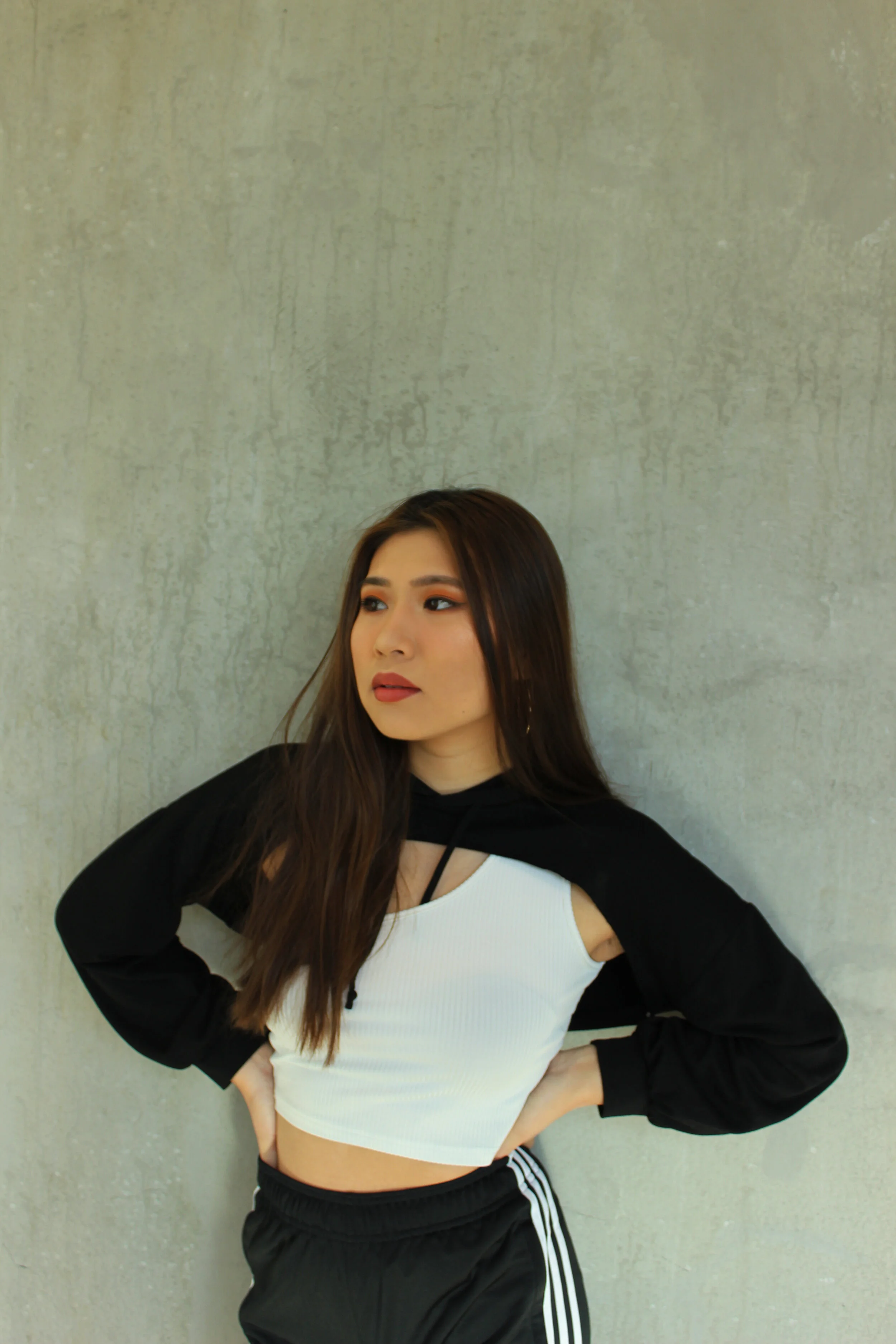
But now Chiara has learned that beauty is subjective, and because she has matured, she is more confident about herself.
She doesn’t think there should be specific standards that define whether a person is beautiful or not. “Once you get to know a person better, if their personality is an amazing personality, you start switching your perspective,” says Chiara. “Beauty is an idea we have in our minds, but that idea isn’t as stiff as we think.”
She does believe that the industry is in a better situation than it was even just a year ago, or a decade ago. When asked what was great about the fashion industry in 2019, Chiara remembered the Savage Fenty show and Rihanna’s beauty line. “It was very inspiring and shows us that we are on the right track,” says Chiara. “We’re not perfect and there’s a lot of space for improvement, but we’re on the right track.”
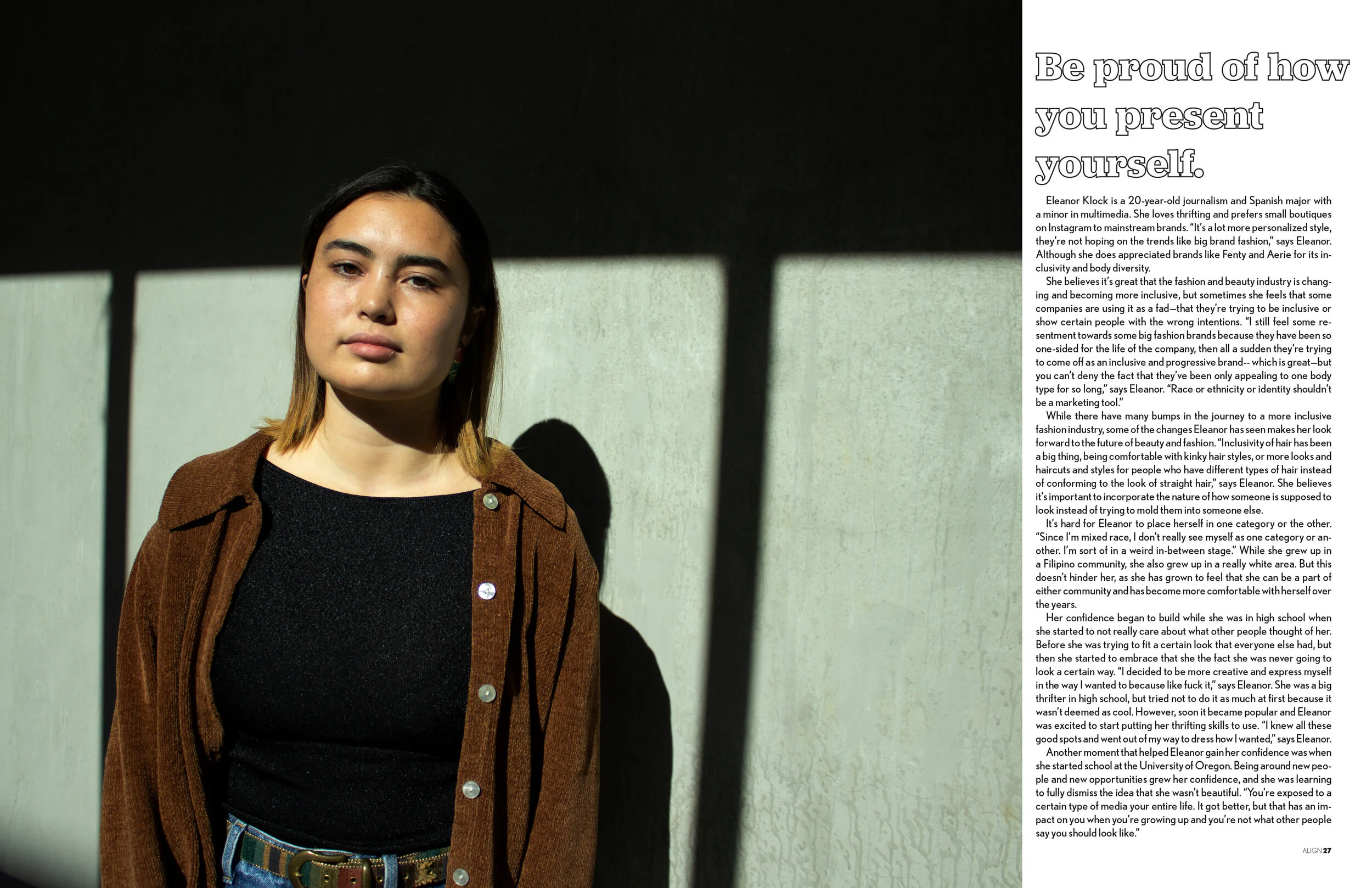
Eleanor Klock
Eleanor Klock is a 20-year-old journalism and Spanish major with a minor in multimedia. She loves thrifting and prefers small boutiques on Instagram to mainstream brands. “It’s a lot more personalized style, they’re not hoping on the trends like big brand fashion,” says Eleanor. Although she does appreciated brands like Fenty and Aerie for its inclusivity and body diversity.
She believes it’s great that the fashion and beauty industry is changing and becoming more inclusive, but sometimes she feels that some companies are using it as a fad—that they’re trying to be inclusive or show certain people with the wrong intentions. “I still feel some resentment towards some big fashion brands because they have been so one-sided for the life of the company, then all a sudden they’re trying to come off as an inclusive and progressive brand-- which is great—but you can’t deny the fact that they’ve been only appealing to one body type for so long,” says Eleanor. “Race or ethnicity or identity shouldn’t be a marketing tool.”
While there have many bumps in the journey to a more inclusive fashion industry, some of the changes Eleanor has seen makes her look forward to the future of beauty and fashion. “Inclusivity of hair has been a big thing, being comfortable with kinky hair styles, or more looks and haircuts and styles for people who have different types of hair instead of conforming to the look of straight hair,” says Eleanor.
She believes it’s important to incorporate the nature of how someone is supposed to look instead of trying to mold them into someone else.
It’s hard for Eleanor to place herself in one category or the other. “Since I’m mixed race, I don’t really see myself as one category or another. I’m sort of in a weird in-between stage.” While she grew up in a Filipino community, she also grew up in a really white area. But this doesn’t hinder her, as she has grown to feel that she can be a part of either community and has become more comfortable with herself over the years.
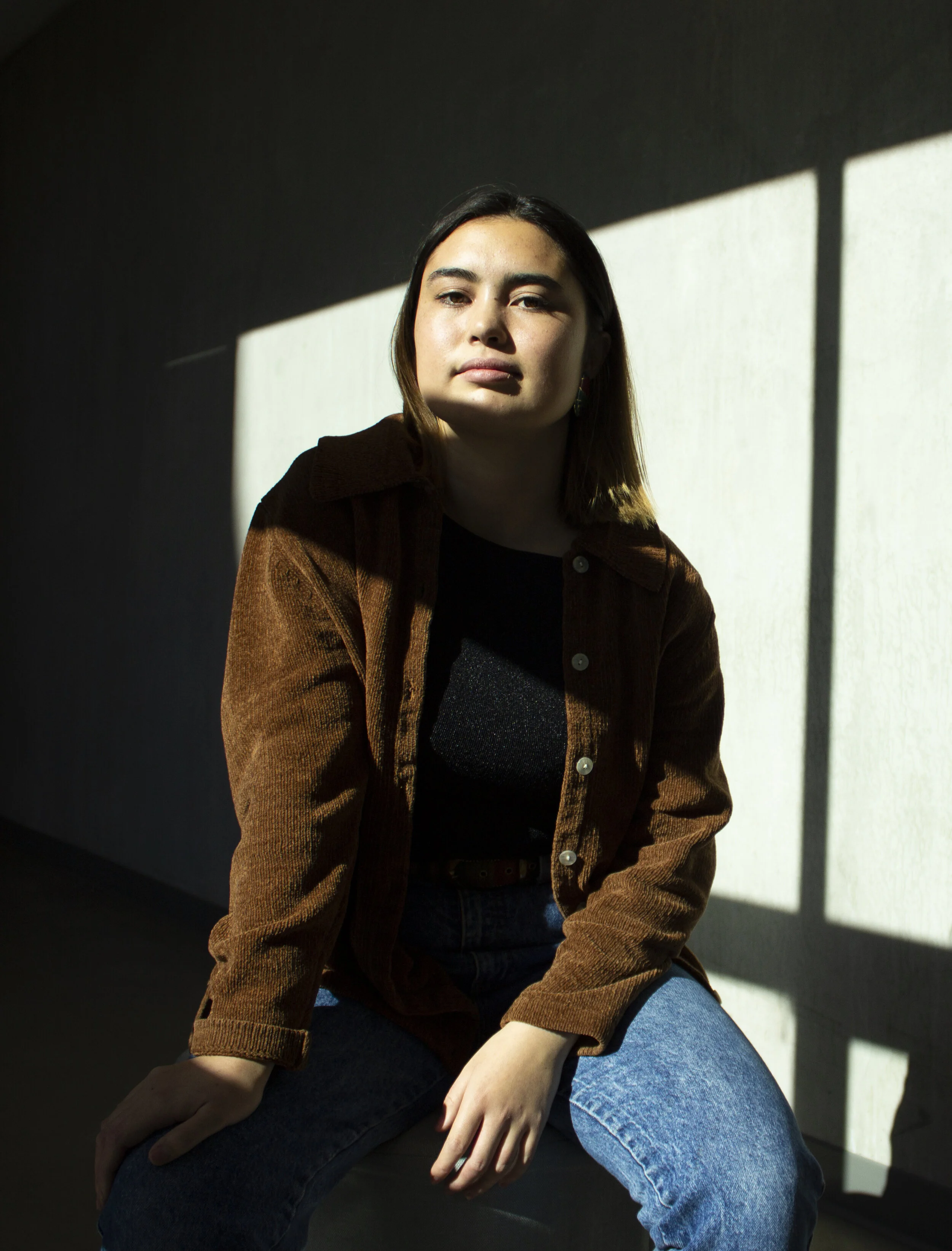
Her confidence began to build while she was in high school when she started to not really care about what other people thought of her. Before she was trying to fit a certain look that everyone else had, but then she started to embrace that she the fact she was never going to look a certain way. “I decided to be more creative and express myself in the way I wanted to because like fuck it,” says Eleanor. She was a big thrifter in high school, but tried not to do it as much at first because it wasn’t deemed as cool. However, soon it became popular and Eleanor was excited to start putting her thrifting skills to use. “I knew all these good spots and went out of my way to dress how I wanted,” says Eleanor.
Another moment that helped Eleanor gain her confidence was when she started school at the University of Oregon. Being around new people and new opportunities grew her confidence, and she was learning to fully dismiss the idea that she wasn’t beautiful. “You’re exposed to a certain type of media your entire life. It got better, but that has an impact on you when you’re growing up and you’re not what other people say you should look like.”
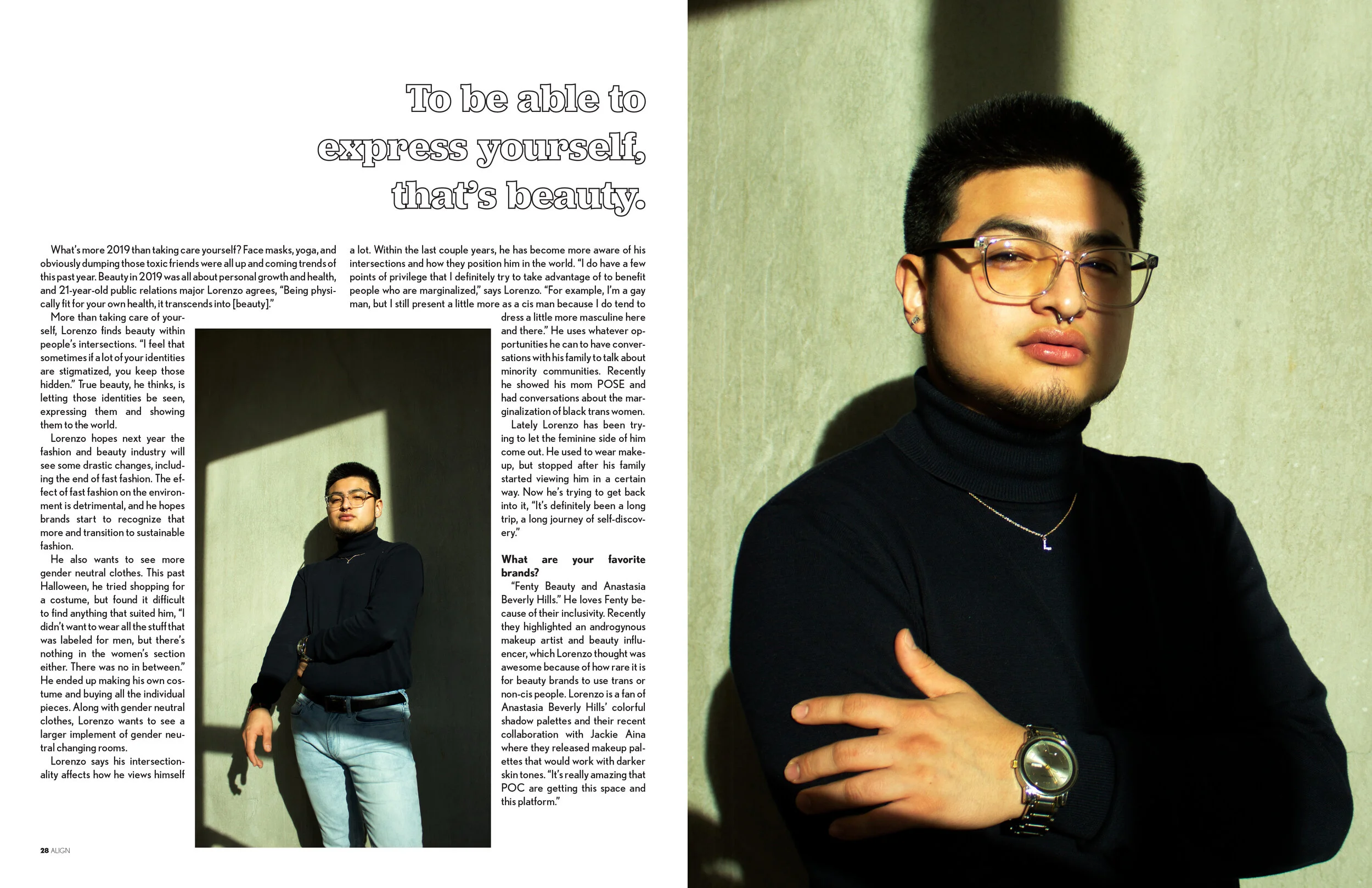
Lorenzo
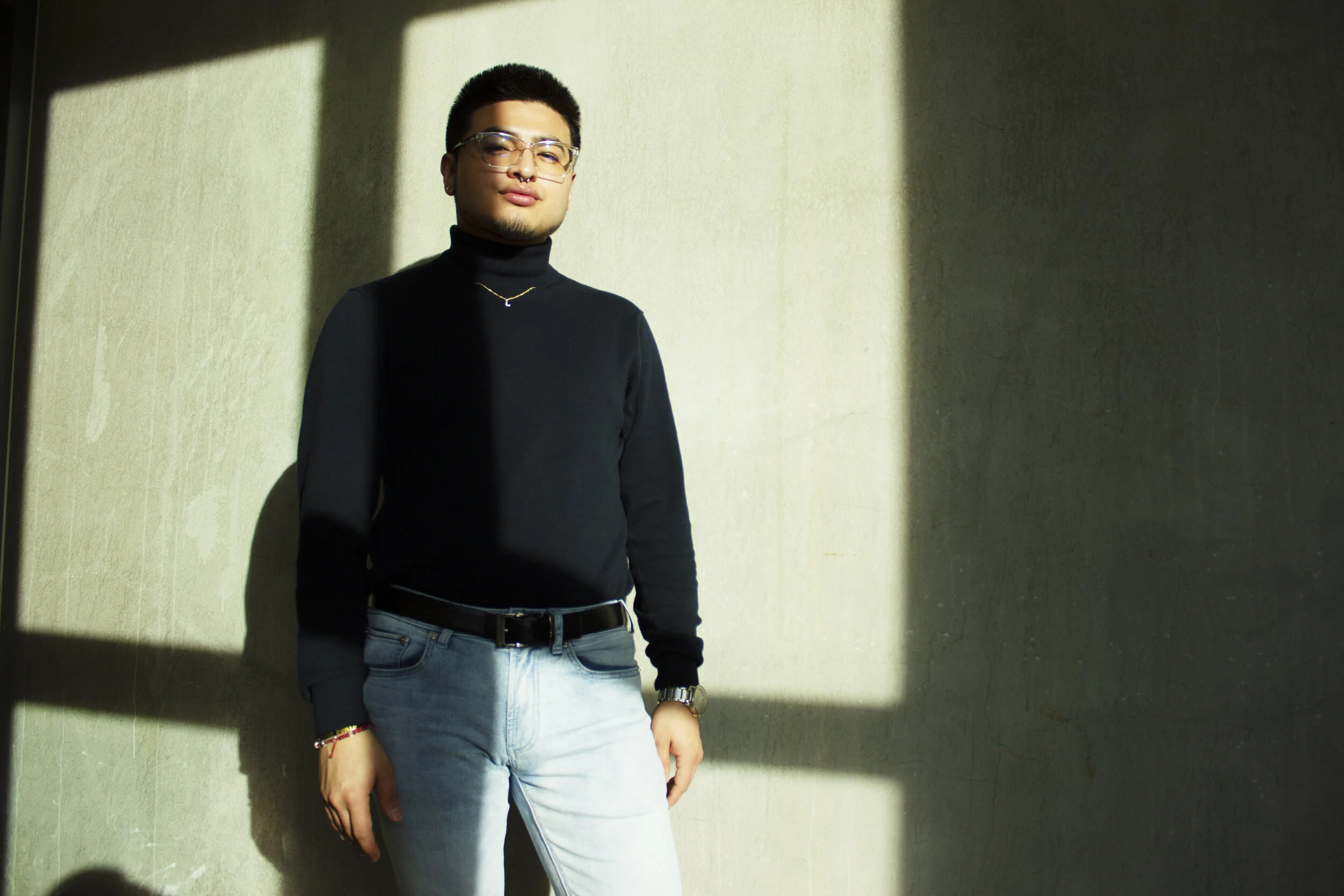
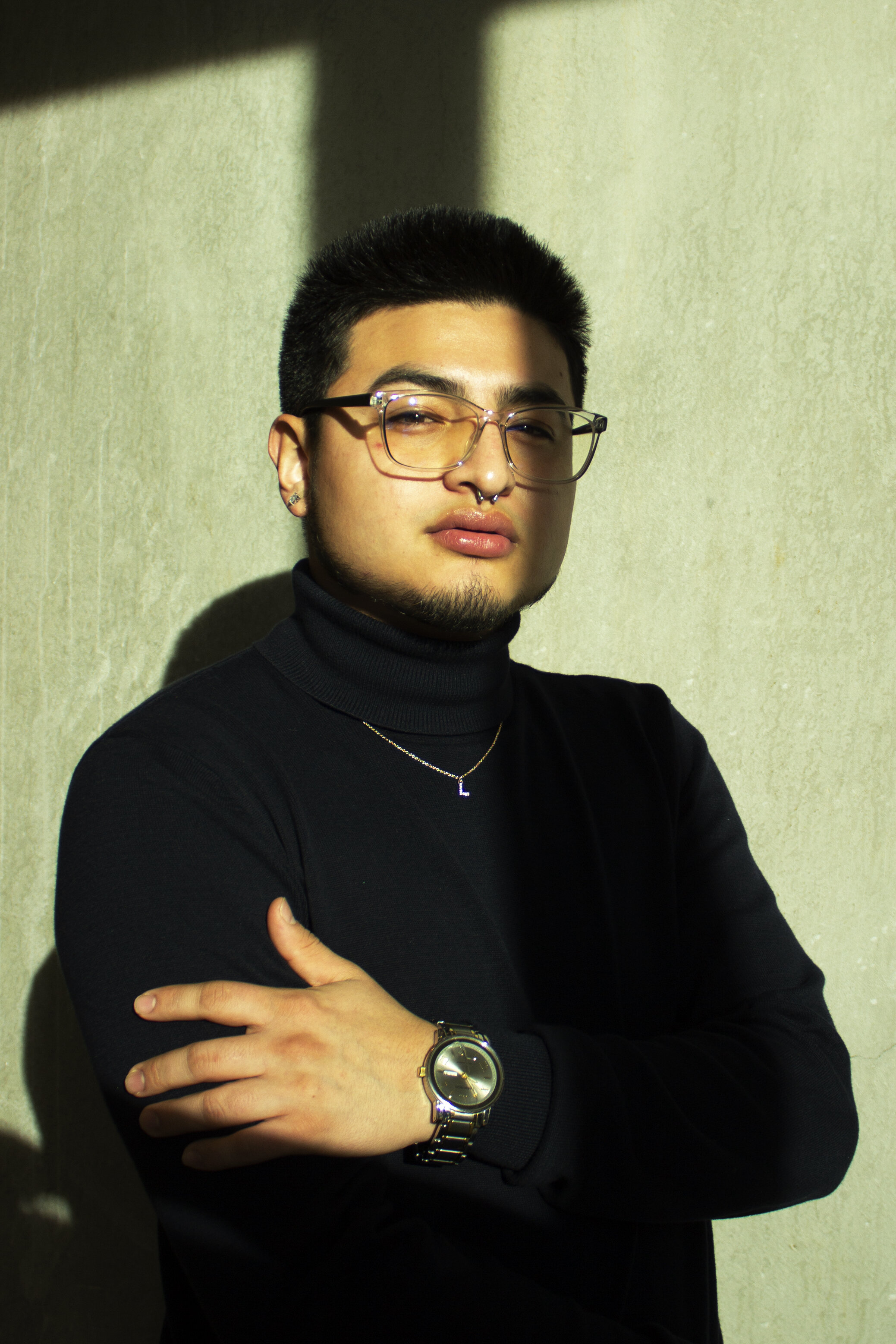
What’s more 2019 than taking care yourself? Face masks, yoga, and obviously dumping those toxic friends were all up and coming trends of this past year. Beauty in 2019 was all about personal growth and health, and 21-year-old public relations major Lorenzo agrees, “Being physically fit for your own health, it transcends into [beauty].”
More than taking care of yourself, Lorenzo finds beauty within people’s intersections. “I feel that sometimes if a lot of your identities are stigmatized, you keep those hidden.” True beauty, he thinks, is letting those identities be seen, expressing them and showing them to the world.
Lorenzo hopes next year the fashion and beauty industry will see some drastic changes, including the end of fast fashion. The effect of fast fashion on the environment is detrimental, and he hopes brands start to recognize that more and transition to sustainable fashion.
He also wants to see more gender neutral clothes. This past Halloween, he tried shopping for a costume, but found it difficult to find anything that suited him, “I didn’t want to wear all the stuff that was labeled for men, but there’s nothing in the women’s section either. There was no in between.” He ended up making his own costume and buying all the individual pieces. Along with gender neutral clothes, Lorenzo wants to see a larger implementation of gender neutral changing rooms.
“I do have a few points of privilege that I definitely try to take advantage of to benefit people who are marginalized.”
Lorenzo says his intersectionality affects how he views himself a lot. Within the last couple years, he has become more aware of his intersections and how they position him in the world. “I do have a few points of privilege that I definitely try to take advantage of to benefit people who are marginalized,” says Lorenzo. “For example, I’m a gay man, but I still present a little more as a cis man because I do tend to dress a little more masculine here and there.” He uses whatever opportunities he can to have conversations with his family to talk about minority communities. Recently he showed his mom POSE and had conversations about the marginalization of black trans women.
Lately Lorenzo has been trying to let the feminine side of him come out. He used to wear makeup, but stopped after his family started viewing him in a certain way. Now he’s trying to get back into it, “It’s definitely been a long trip, a long journey of self-discovery.”
What are your favorite brands?
“Fenty Beauty and Anastasia Beverly Hills.” He loves Fenty because of their inclusivity. Recently they highlighted an androgynous makeup artist and beauty influencer, which Lorenzo thought was awesome because of how rare it is for beauty brands to use trans or non-cis people. Lorenzo is a fan of Anastasia Beverly Hills’ colorful shadow palettes and their recent collaboration with Jackie Aina where they released makeup palettes that would work with darker skin tones. “It’s really amazing that POC are getting this space and this platform.”
Published in Align Magazine, Winter 2020